This Disc Won’t Play! Part II – Scratch That Idea

So you’ve wiped down your CD or DVD, buffed it shiny, but it still skips, chirps, freezes, and refuses even to advance to the next section.  Now you’ve got a problem. Check that mirrored side.  Chances are, it’s covered with scratches.  Small scratches, especially those on audio media like CDs and audiobooks, and those that run outward from the center to the edge of the disc, may not have any effect at all on performance.  DVDs, however, are much fussier, and a minor ding may create havoc.  Scratches that run around the disc like an old record interfere the most.
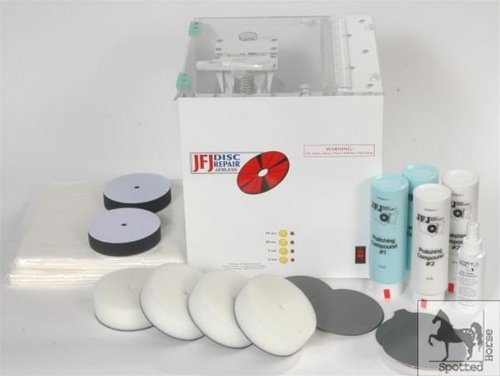
41I5j7KgWNL Cheshire Public Library has professional equipment for resurfacing media discs.  If simply washing and wiping doesn’t help, we put troubled discs through a three-step process. Seriously damaged discs are scoured smooth with fine sandpaper, then buffed back into shape at high speed, and finished off with a polishing coat of protectant. Usually this is enough to bring them back into good-as-new shape. Small, light scratches will disappear; deep gouges – the kind you can click with your fingernail – are a very bad sign and usually cannot be repaired.

brokenSome damage cannot be fixed. Disc materials are a layer of polycarbonate, a layer of foil, and a layer of lacquer. Any damage to the foil layer, from pen marks, pavement divots, dog teeth, to separation of layers and peeling, is a death sentence for the disc. Likewise, cracks cannot be repaired, because they interfere with that all-important foil layer where the data is stored. Blu-Ray discs are generally much tougher than regular discs, which is good, because they cannot be repaired at all. Blu-Rays have a heavier coating that the cleaning machine cannot penetrate. Amazingly, despite several years of use, we have lost perhaps only two Blu-ray discs because of scratch damage.

The easiest way to keep discs working well is to be gentle with them!  Don’t wrestle them from packaging but press that center hub until the disk releases. Always handle them by the edges, and replace them in their case as soon as you are finished with them.  Make sure they click onto that hub – shaking around loose in the case will scratch them! Don’t let children play with them, and don’t leave them where your dog can chew them. Be especially careful with items you listen to in the car: the sand you carry in the carpeting of your automobile can damage a disc exceptionally fast. If a disc won’t work, let us know, so we can fix it as soon as possible – tell us which disc of a set, which scene or which track if possible.  If the case is broken and the disc is rattling inside, tell us, because those broken hubs are little scratch factories. Disc materials are an expensive part of library acquisitions, and we work hard to keep them in the best shape they can be.

Book Review: The Bell Jar by Sylvia Plath

Our classics pick for April is The Bell Jar by Sylvia Plath. I had picked this book a while ago, not knowing it was the 50th anniversary this year of the publication.

The Bell Jar by Sylvia Plath

I was warned when I picked this book that it would be “terribly depressing” and “Ooo, that’s so depressing I’m not sure I want to read it.” While this book was depressing, that was not the whole of the story.

The Bell Jar is a coming of age story that takes place in 1953 and centers around main character Esther Greenwood, a 21 year old college student. She is bright, but has a difficult time reconciling with the stifling world of the 1950’s.  Esther works for a fashion magazine in NYC during the summer of 1953 and is fascinated with the news headlines of the day, including the execution of the Rosenbergs and a man’s suicide. It appears that Esther may be on the track to bigger and better things.

But Esther is not as stable as she presents herself. This is a coming of age story, like The Catcher In the Rye, but it is through rebirth and pain. Esther begins a slow decline into mental illness, so slowly it’s almost impossible to remember what the “trigger” was for her. In her rejection of conventional models of woman,, like purity, relationships with men, and the fashion world of NYC, she finds herself on the outside looking in. I found myself, when reading of Esther’s first suicide attempt, wondering “Well, where did that come from?” Esther had no reason to try to kill herself, she even says that she wants to see if she can do it.

Plath’s use of language, imagery, and tone in The Bell Jar allowed the reader into the mind and life of Esther Greenwood. Plath is simply a genius when it comes to weaving a story. A slim 264 pages, it was easy reading.

One of the reasons I liked this book so much was that I found so much of myself in Esther Greenwood. At that age, I too was bright, ambitious, and sometimes on the brink. But unlike Esther, I had the mental fortitude and support system to bring me back from the edge.

I listened to this book on audio and it was read by Maggie Gyllenhaal. I found her reading to be less than stellar, as she read…. like… she.. was… taking… her… time. It was extremely annoying, but I was able to look past her inept reading and hear the heart of the story.

Rating: 4 stars

This Disc Won’t Play! (part 1, Fingering the Culprit)

imagesYou’ve put in your favorite CD or DVD, and the stupid thing just won’t play!  It skips, it freezes, it pixelates into pretty colors, or the player spits it out and declares “Bad Disc!”  Your heart was set on that, and now you’re out of luck and your kids are getting cranky.

Don’t despair! The solution is often very simple. By far, the most common, annoying, easily fixable problem with disc materials is FINGERPRINTS.  Turn it over and look at the non-label side. It should look like a mirror.  Are there fingerprints?  Is coffee spilled on it? Or maple syrup (that’s happened)?  CLEAN THE DISC.

“But it’s a library disc!” you say.  “If I damage it, they’ll charge me!”  Don’t worry.  While discs are fragile, they’re more durable than you think.  Some of our discs have been used more than 150 times and still play fine. CDs and DVDs are made from polycarbonate, with a layer of foil (gold or aluminum) protected by a layer of lacquer.  That’s the same plastic as your eyeglasses!  General rule is, if it’s safe for your eyeglasses, it’s perfectly safe for a disc.  You can clean them with eyeglass cleaner, water, hand sanitizer, baby wipes, even liquid dish soap, but *make sure you clean them with a liquid*.  You can even rinse them under the tap if you must. To dry them, you can use a glass-cleaning cloth, a clean piece of flannel, or in a pinch, a clean cotton dishcloth or Tshirt.

DON’T: rub the mark with something dry, use a paper towel, newspaper, or rough cloth.  All these things will leave fine scratches on the polycarbonate.  If the laser can’t penetrate the polycarbonate layer, it can’t read your disc.  You can clean them with Windex or window cleaner, but repeated exposure to the ammonia in them can eventually dull and damage your disc. Don’t run them through the dishwasher.

cd-cleaningClean the disc, try it again.  Audio CDs (music or audiobooks) are very forgiving.  They can look scratched and still play fine. Sometimes it’s the player: what plays perfectly in your computer or your cd player won’t play right in your car. DVDs, with their video component, are much fussier, and Blu-rays the fussiest of all.  If it still won’t play right, bring it back, but stick a note on it or tell us, and we’ll give it a more thorough diagnostic.  Be especially careful with those awful double-sided DVDs – always hold them from the very edge, or you’ll be cleaning one side while dirtying the other.

With a little polish and a little luck, you’ll be singing along again in no time!

Congrats to ALA’s Youth Media Award Winners for 2013!

[Cover]

Newbery Award  : The One and Only Ivan by Katherine Applegate. Award given for the most outstanding contribution to children’s literature.

[Cover]


Caldecott Award : This is Not My Hat by Jon Klassen. Award given for the most distinguished American picture book for children.

[Cover]


Coretta Scott King (Author) Book Award : Hand in Hand : Ten Black Men Who Changed America by Andrea Davis Pinkney. Award given to recognize an African American author of outstanding books for children and young adults.

[Cover]


Coretta Scott King (Illustrator) Book Award : I, too, am America illustrated by Bryan Collier. Award given to recognize an African American illustrator of outstanding books for children and young adults.

[Cover]


Michael L. Printz Award : In Darkness by Nick Lake. Award given for excellence in literature written for young adults.

[Cover]


Odyssey Award : The Fault in Our Stars by John Green and narrated by Kate Rudd. Award given for best audiobook produced for children and/or young adults.

[Cover]


Theodor Seuss Geisel Award : Up, Tall and High! by Ethan Long. Award given for the most distinguished beginning reader book.